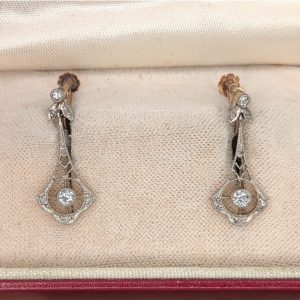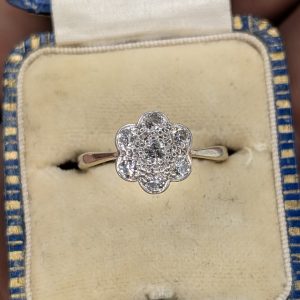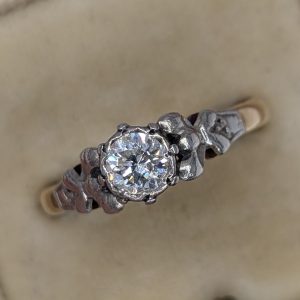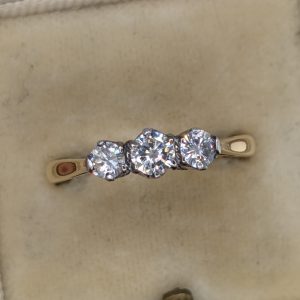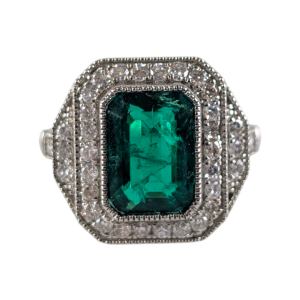
Diamonds have been cut for centuries, but the dazzling, almost perfectly symmetrical round brilliant diamond we recognise today is relatively modern.
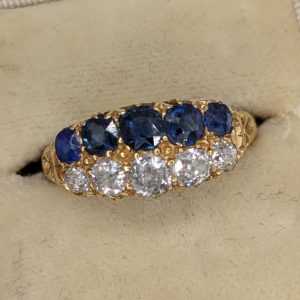
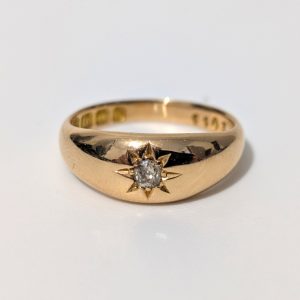
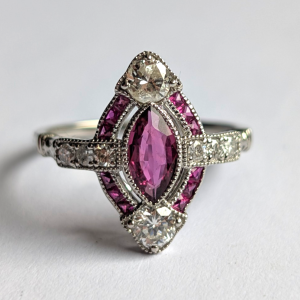
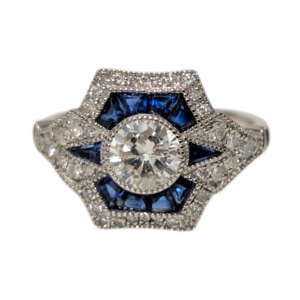
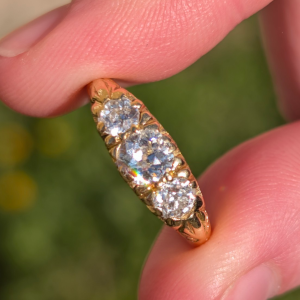
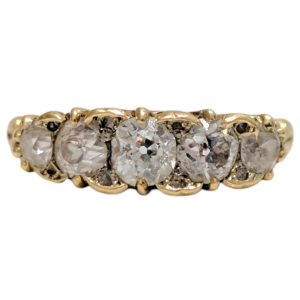
Look closely at a diamond in a genuine Victorian or Edwardian ring and it can appear almost like a different gemstone altogether. The facets are broader. The outline may not be perfectly round. The stone can sit unusually high in its setting and, when viewed from above, there may even be what looks like a tiny hole or dark spot in its centre.
These are not necessarily imperfections.
They are often the fingerprints of an old cut diamond — a stone shaped by hand during an era when cutters were working without computer modelling, laser cutting equipment or the extraordinarily precise machinery used by the modern diamond industry.
Old cut diamonds have consequently developed a following of their own. Some collectors actively choose them over modern diamonds, not because they produce more brilliance in a technical sense, but because their larger facets and irregular proportions create a very different type of light.
Understanding the difference becomes particularly useful when buying antique diamond jewellery, as the diamond itself can provide important clues about the age and character of a piece.
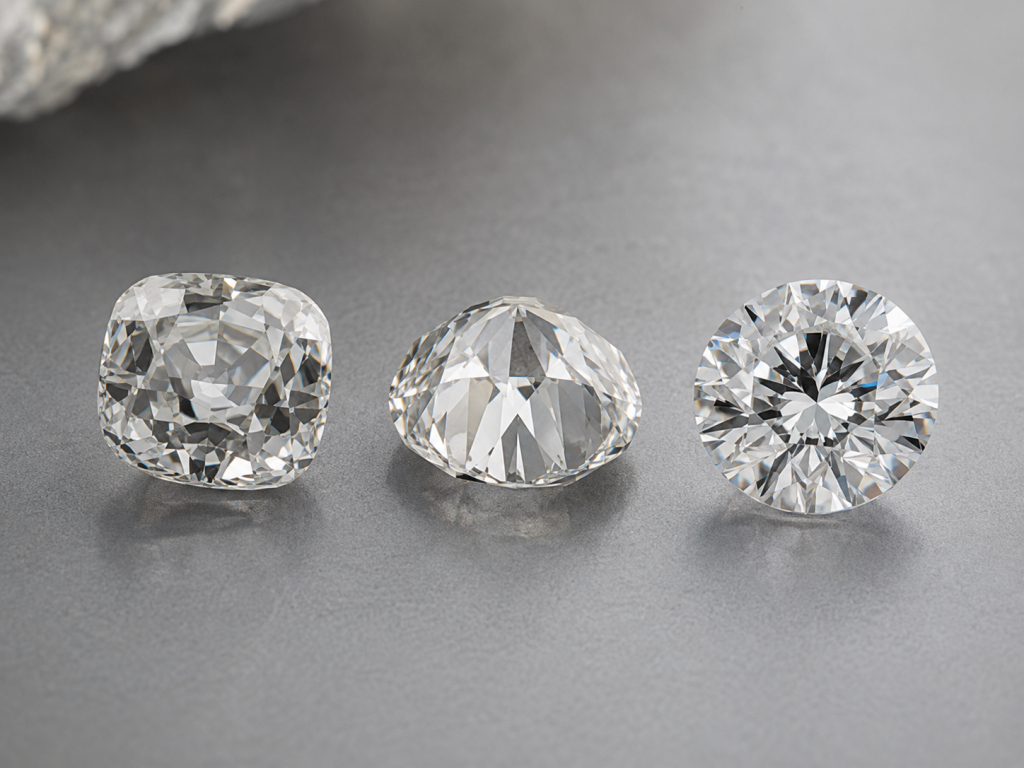
What Is an Old Cut Diamond?
“Old cut diamond” is an umbrella term rather than one single diamond shape.
It generally describes diamonds fashioned using cutting styles that pre-date the modern brilliant cut. Among the most commonly encountered in antique jewellery are:
- Old mine cut diamonds
- Old European cut diamonds
- Rose cut diamonds
- Earlier cushion and brilliant-style cuts
Of these, the old mine cut and old European cut are probably the two most important for anyone buying Victorian, Edwardian or early 20th-century jewellery.
Although no two antique diamonds are identical, old cuts often share several characteristics:
- Larger, broader facets
- A relatively high crown
- A smaller table
- Greater overall depth
- A visible culet
- Less precise symmetry
- Individually shaped outlines
The result is a stone with a noticeably different personality from a modern brilliant.
Modern diamonds tend to produce countless rapid flashes of white and coloured light. Old cuts often produce larger, slower flashes across broader facets.
Collectors sometimes describe this as a softer or more romantic sparkle.
It is difficult to appreciate fully from a photograph because much of the appeal becomes apparent when the jewellery moves.
Turn an old European cut diamond slowly under a light and entire facets can illuminate before disappearing again. A modern brilliant tends to break the same light into a much busier pattern of smaller reflections.
Neither is automatically better.
They are simply different approaches to making a diamond interact with light.
Old Mine Cut Diamonds
The old mine cut diamond, sometimes abbreviated to OMC, is one of the most recognisable antique diamond cuts.
Old mine cuts were particularly common during the Georgian and Victorian periods, although examples continued to appear later.
Rather than being perfectly round, an old mine cut usually has a rounded square or cushion-shaped outline.
Think of a square whose corners have been softened considerably.
Because they were fashioned individually by hand, however, their shapes can vary enormously. One stone may be almost square, another distinctly cushion-shaped and another sufficiently irregular that describing its exact outline becomes difficult.
That irregularity is part of their appeal.
Typical characteristics of an old mine cut diamond
An old mine cut will commonly display:
A cushion-shaped outline
This is often the easiest feature to notice. Unlike a modern round brilliant, many old mine cuts appear squarish or pillow-shaped.
A small table
The table is the large flat facet visible at the top of a diamond. On many old mine cuts it is noticeably smaller than on a modern brilliant.
A high crown
The section of the diamond above the girdle tends to rise relatively steeply.
Seen from the side, some old mine cuts appear almost architectural compared with today’s flatter-looking diamonds.
A deep pavilion
The underside of the diamond can also be comparatively deep.
This means an antique diamond may carry more of its carat weight vertically rather than across its visible diameter.
A one-carat old mine cut may therefore appear smaller face-up than a well-proportioned modern one-carat round brilliant.
A large open culet
Perhaps the most famous feature of old cut diamonds.
The culet is located at the very bottom of the diamond’s pavilion.
Modern brilliant diamonds generally come to a point or have an extremely small culet. Antique diamonds were commonly polished with a flat culet facet instead.
When viewed through the table, a sufficiently large culet can therefore appear as a tiny polygon or dark opening near the centre of the diamond.
People unfamiliar with antique diamonds sometimes mistake this for damage.
In reality, it may be exactly what you would expect to see.
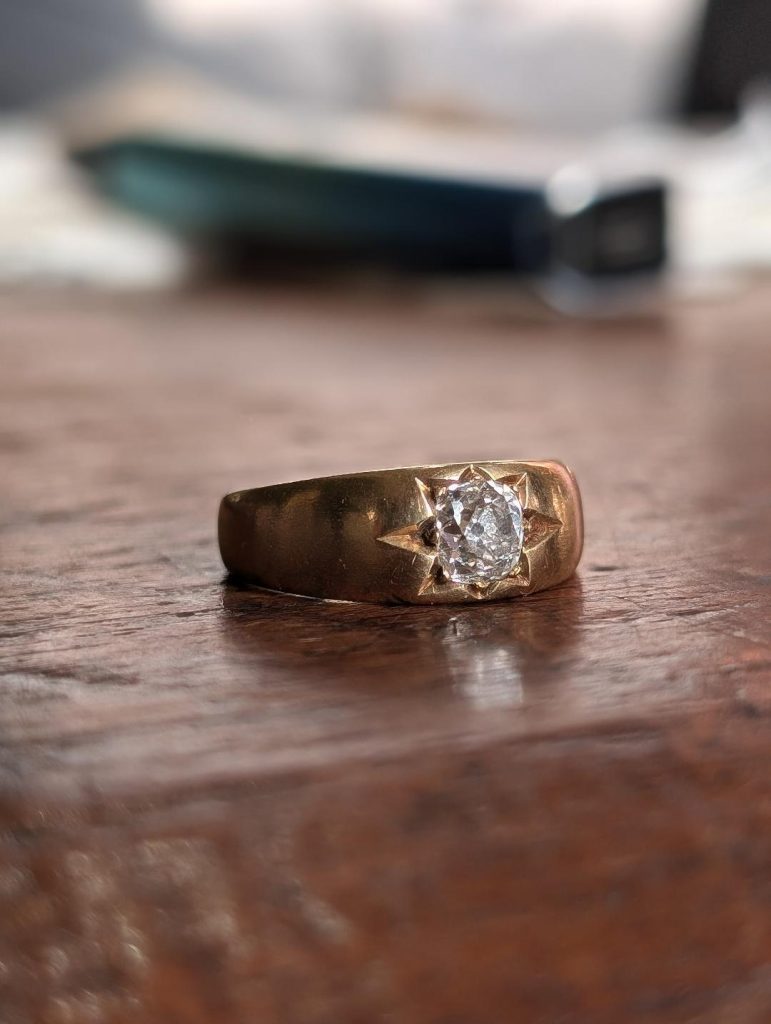
Why Do Old Mine Cut Diamonds Look So Different?
Modern diamond cutting revolves heavily around calculated proportions and controlled light return.
Historical cutters had a different set of tools and priorities.
An antique cutter was working with the individual rough diamond in front of him. Preserving valuable weight mattered, and the natural shape of that rough could heavily influence the finished stone.
Rather than forcing every diamond into an identical template, the cutter adapted.
That is one reason antique diamonds often feel so individual.
You might find an old mine cut with one corner slightly broader than another, an off-centre culet or facets that would never pass the strict symmetry grading expected of a fine modern brilliant.
Yet put that same diamond back into the Victorian ring for which it was cut and those irregularities can look entirely appropriate.
Removing them by recutting the diamond would arguably remove part of its history as well.
Old European Cut Diamonds
As diamond cutting developed, the rounded old European cut became increasingly prominent during the late Victorian, Edwardian and early Art Deco periods.
It can be thought of as an important evolutionary step between earlier old mine cuts and the modern round brilliant.
The abbreviation OEC is commonly used by dealers and collectors.
At first glance an old European cut may appear similar to a modern round diamond because both have a generally circular outline.
Look more closely, however, and significant differences begin to appear.
Features of an old European cut
Typical characteristics include:
- Round outline
- High crown
- Relatively small table
- Deep overall proportions
- Broad, chunky facets
- Open or visible culet
- Less mathematically perfect symmetry
An old European cut is generally more circular than an old mine cut, but it retains the characteristic broad facet pattern and often visible culet associated with antique diamond cutting.
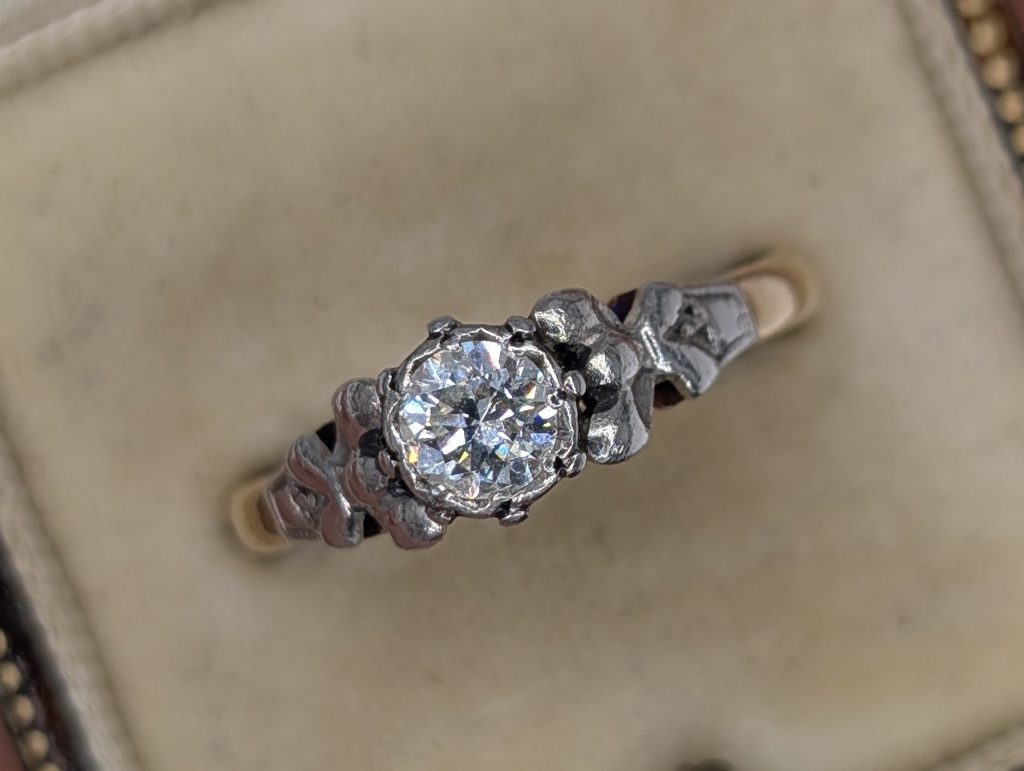
The “Flower” Pattern of an Old European Cut
One of the most attractive characteristics of some old European diamonds is their facet pattern when viewed face-up.
Rather than the extremely precise, almost kaleidoscopic pattern of a modern brilliant, the larger facets can create shapes resembling broad petals surrounding the centre of the stone.
Move the ring under lighting and those facets switch on and off in large sections.
A particularly attractive old European cut can therefore possess remarkable character even if its proportions would be considered far from ideal according to modern cutting standards.
This is an important point when judging antique diamonds.
Applying modern cut criteria too rigidly can miss what makes an old stone desirable.
An old European diamond does not need to look like a modern brilliant.
If it did, there would be little reason to seek one out.
What Is a Modern Round Brilliant Cut Diamond?
The modern round brilliant cut represents generations of development in understanding how light travels through a diamond.
It normally contains 57 or 58 facets, depending on whether the culet is counted.
While diamond cutters had experimented with brilliant-style faceting long before the 20th century, the work of mathematicians and cutters — most famously Marcel Tolkowsky’s 1919 analysis of diamond proportions — helped influence the evolution towards the modern round brilliant.
Modern technology subsequently made increasingly precise cutting possible.
Today’s better-cut round brilliant diamonds can exhibit extraordinary symmetry.
The facets are positioned to maximise the amount of light entering the stone and returning through the crown towards the viewer.
This creates the intense brightness and rapid scintillation most consumers now associate with a diamond.
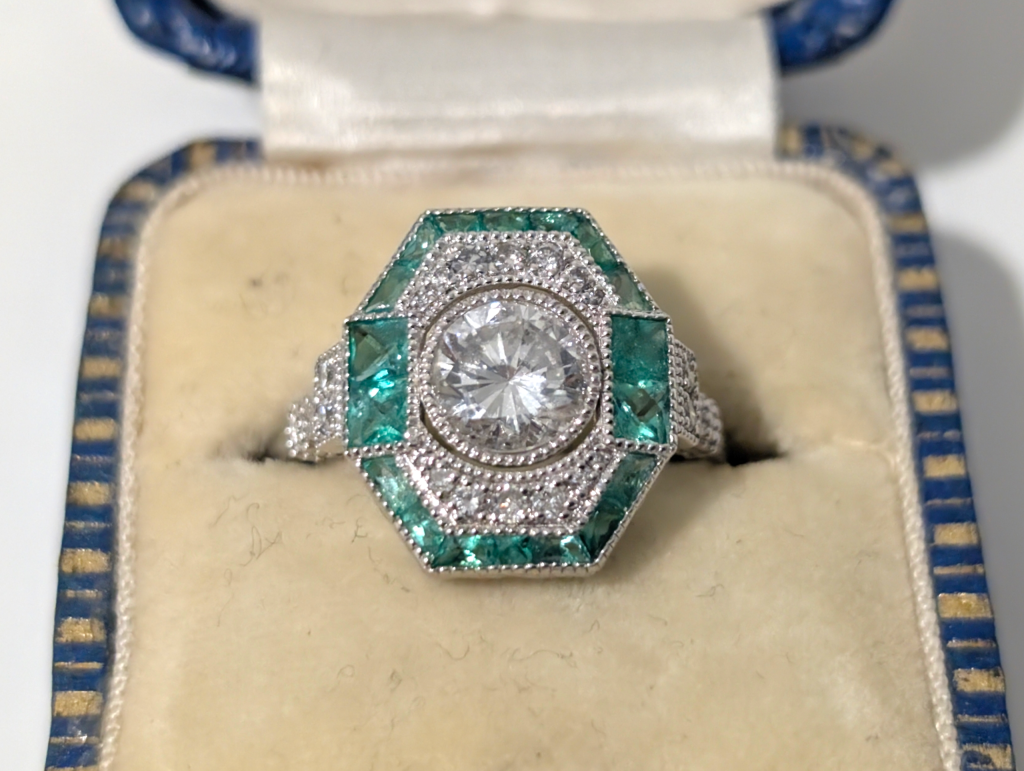
Old Cut Diamond vs Modern Brilliant: The Main Differences
Put an old European cut beside a modern round brilliant and the contrast can be surprisingly dramatic.
1. Facet Size
Old cut diamonds generally have broader and larger-looking facets.
Modern brilliants divide light through a much more precise arrangement, producing numerous smaller flashes.
Imagine light reflecting from a series of large mirrors compared with dozens of smaller ones.
That is not a perfect scientific analogy, but it describes the visual difference rather well.
Old cuts can produce broad flashes of light that seem to roll across the diamond as it moves.
Modern brilliants usually create more constant scintillation.
2. Table Size
The table is the large flat facet at the top of a diamond.
Old mine and old European cuts frequently have comparatively small tables.
Modern round brilliants usually have noticeably larger tables relative to the stone’s diameter.
Looking directly down at the diamond can therefore provide an immediate clue.
A small table combined with a tall crown and visible culet deserves closer inspection.
3. Crown Height
Old cuts are famous for their high crowns.
The crown is the upper portion of the diamond between the girdle and table.
Viewed from the side, antique diamonds can appear distinctly taller or more domed.
Modern round brilliants generally have proportions calculated to balance spread, brilliance and light performance.
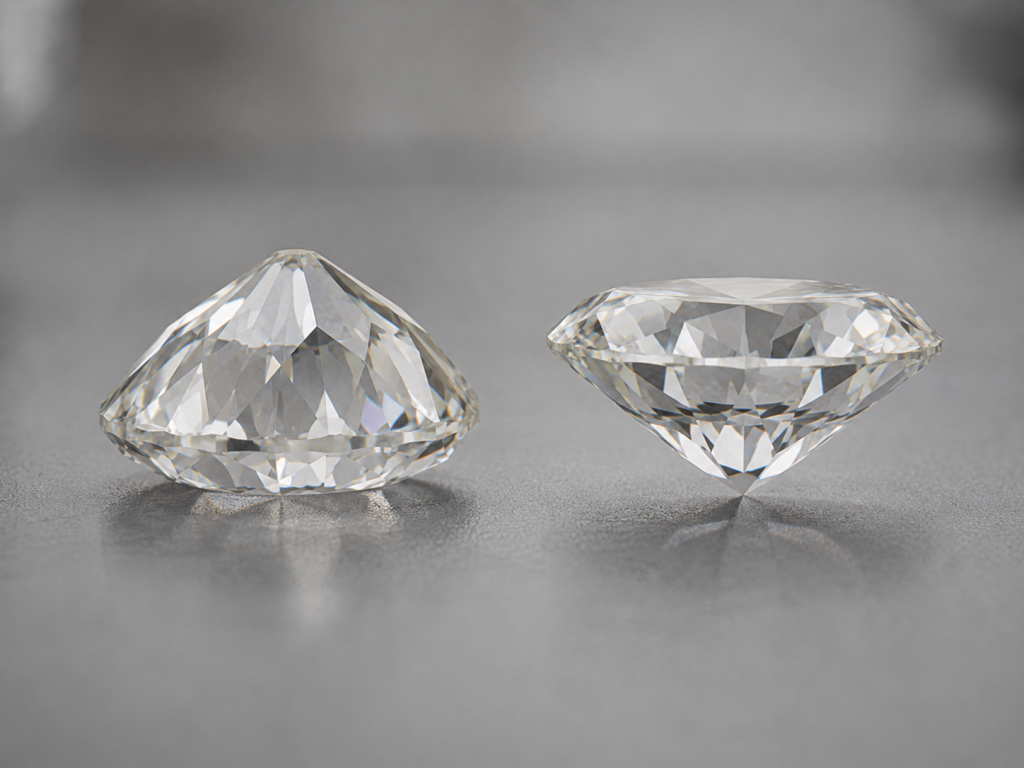
4. The Culet
The culet can be one of the easiest ways to distinguish many old cut diamonds.
In a modern brilliant, the pavilion typically ends in a point.
Old cuts frequently have a polished facet at the bottom.
Viewed through the top of the stone this can appear as:
- A small dark spot
- A clear polygon
- A tiny window
- An off-centre opening
The size varies considerably.
Some old cut diamonds have a pronounced culet while others have only a small one.
Its presence alone does not definitively date a diamond, but alongside other characteristics it can be extremely useful.
5. Symmetry
Modern diamond cutting can achieve remarkable precision.
The outline of a fine modern round brilliant may appear almost perfectly circular, with facets arranged in an extremely regular pattern.
Antique diamonds are often less disciplined.
A facet might be slightly larger on one side. The culet might sit off-centre. The girdle can vary in thickness. An old mine cut may be noticeably asymmetrical.
For collectors, these are not always defects.
They are evidence of hand cutting.
There is an important distinction between charming irregularity and genuinely poor cutting, but perfect symmetry should not automatically be expected from a diamond cut more than a century ago.
Which Sparkles More: Old Cut or Modern Brilliant?
If the question is purely about maximising measurable light return, a finely cut modern brilliant usually has the advantage.
That is exactly what the modern brilliant has been developed to do.
But sparkle is more complicated than simply asking which stone is brightest.
Old cuts often produce a different form of visual performance.
Modern brilliant
Expect:
- Strong overall brightness
- Rapid scintillation
- Numerous small flashes
- Pronounced contrast patterns
- Considerable fire in suitable lighting
Old cut
Expect:
- Broader flashes
- Chunkier facet reflections
- A softer pattern of light
- Strong flashes of colour from certain angles
- Greater visual variation between individual stones
There are magnificent examples and poor examples of both.
An exceptional old European cut can be extraordinarily lively.
Likewise, a badly proportioned modern brilliant can appear surprisingly dull despite its more recent cutting style.
Why Old Cut Diamonds Look Incredible in Candlelight
One reason collectors fall in love with antique diamonds is the way they react to softer lighting.
Victorian and Edwardian jewellery existed long before the bright LED lighting now surrounding us.
Gaslight, candlelight and comparatively warm interior illumination formed part of the environment in which these jewels were worn.
The broad facets of old diamonds can produce dramatic flashes under this type of lighting.
Rather than creating a uniform wall of brilliance, parts of the diamond seem to suddenly ignite.
This is particularly noticeable with larger old mine and old European cuts.
It is also one reason photographs do not always do them justice.
A still photograph captures one instant.
An old cut diamond is at its best when moving.
Are Old Cut Diamonds Less Valuable Than Modern Diamonds?
Not necessarily.
The value of any natural diamond still depends heavily on factors such as:
- Carat weight
- Colour
- Clarity
- Cut quality
- Condition
- Rarity
- Provenance
- The jewellery in which it is mounted
However, desirable old mine and old European cuts now have a specialist collector market.
Large, attractive antique diamonds with appealing shapes and good light performance can command strong prices.
There is also a finite supply.
Unlike modern diamonds, genuinely antique diamonds cannot simply be manufactured again.
A newly cut diamond can imitate an old mine cut, and specialist cutters do produce excellent antique-inspired stones, but it is not a diamond that actually survived the Victorian period.
For buyers of genuine antique jewellery, that distinction matters.
Should an Old Diamond Be Recut?
Historically, many old diamonds were recut into modern brilliants to improve symmetry, colour appearance or light return.
In some circumstances this can still make financial sense.
But with genuinely antique jewellery, recutting should be considered carefully.
An old cut diamond is part of the character of the piece.
Place a perfectly calibrated modern round brilliant into an 1890 Victorian ring and something can immediately feel wrong.
The metalwork is antique but the centre stone suddenly has a completely different visual language.
Re-cutting also removes diamond material.
Because many old cuts are deep, a cutter may need to sacrifice considerable carat weight to produce modern proportions.
For collectors, preserving an attractive original old cut is often preferable.
Can Old Cut Diamonds Be Found in Modern Jewellery?
Yes, and increasingly so.
Antique diamonds are frequently removed from damaged or unwanted jewellery and reset into contemporary rings.
The contrast can be beautiful.
A chunky 19th-century old mine cut placed into a very simple modern bezel setting combines an antique stone with clean contemporary design.
There are also newly cut diamonds intentionally fashioned using old-style proportions.
These may be marketed as antique-style cuts, old mine style diamonds or transitional-inspired cuts.
They can produce a similar appearance, but they should not automatically be described as antique diamonds unless their age can genuinely be supported.
What Is a Transitional Cut Diamond?
Between the classic old European cut and the fully developed modern brilliant lies another interesting category: the transitional cut.
These diamonds are most commonly associated with the early decades of the 20th century as cutters began experimenting with proportions closer to those of modern brilliant diamonds.
A transitional cut may show:
- A somewhat larger table than an old European
- Improved symmetry
- A smaller culet
- More modern-looking facet arrangement
- Characteristics of both antique and modern brilliant cutting
They can be difficult to categorise precisely because diamond cutting did not suddenly change on one particular date.
It evolved.
That grey area is part of what makes studying antique diamonds fascinating.
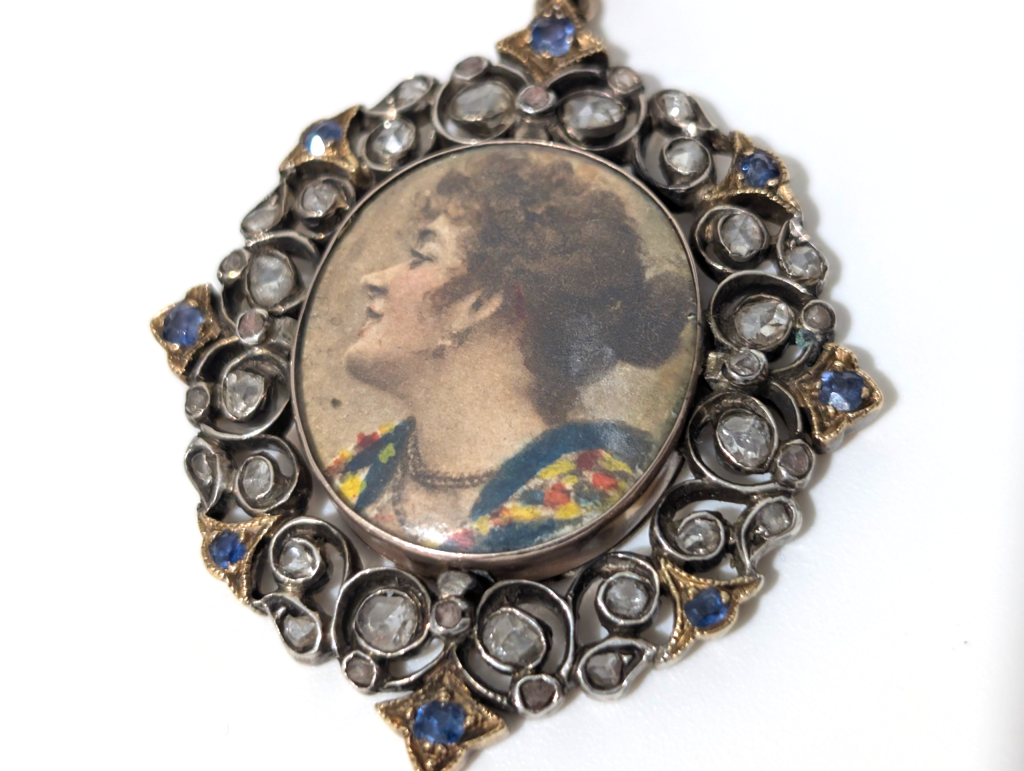
Rose Cut Diamonds: An Even Earlier Look
Although old mine and old European cuts receive most of the attention, antique jewellery enthusiasts will frequently encounter rose cut diamonds.
A rose cut is very different.
Instead of having the deep pavilion associated with brilliant cuts, a traditional rose cut has a relatively flat base with a faceted dome rising above it.
When seen from above, the facets resemble the unfolding petals of a rose — hence the name.
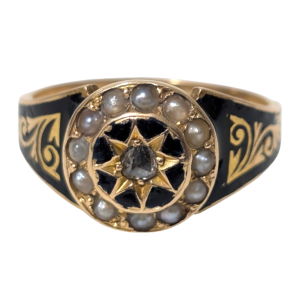
Rose cuts were common centuries before modern brilliant cutting and appear frequently in Georgian jewellery.
They generally produce a gentler shimmer rather than intense brilliance.
Trying to judge one according to modern round brilliant standards misses the point entirely.
Their attraction lies in their historic appearance.
How Can You Tell If a Diamond Is an Old Cut?
No individual feature proves that a diamond is antique.
Instead, look at several characteristics together.
A possible old cut diamond may display:
An open culet
Look down through the table for a small flat facet or apparent hole towards the centre.
Chunky facets
The reflections often look broader and less numerous than those of a modern brilliant.
A small table
Particularly common with old mine and old European cuts.
A high crown
View the stone from the side.
Irregular symmetry
Do not expect machine-like precision.
A cushion or slightly irregular outline
Especially with old mine cuts.
The jewellery itself should also be considered.
Mounting style, construction, wear, hallmarks, metal type and workmanship should all broadly make sense together.
A diamond can be old while its setting is modern, and equally an antique ring may have received a replacement diamond at some point during its life.
Dating jewellery should therefore never rely on the diamond alone.
Old Mine Cut vs Old European Cut
The easiest broad distinction is shape.
An old mine cut is typically cushion-shaped or rounded-square.
An old European cut is generally round.
Both can display high crowns, small tables, large facets and open culets.
Think of the old European cut as representing a later and increasingly round evolution of brilliant-style diamond cutting.
In practice, however, historical diamonds do not always fit neatly into modern categories.
Some stones sit somewhere between recognised cutting styles.
Trying to force every antique diamond into a precise label can sometimes be less useful than simply describing what is actually visible.
Old European Cut vs Modern Round Brilliant
These two are easier to confuse because both are round.
From above, look particularly at:
- Table size
- Culet size
- Facet arrangement
- Symmetry
From the side, compare:
- Crown height
- Pavilion depth
- Overall profile
Once you have handled enough examples, the visual difference becomes surprisingly obvious.
A modern brilliant tends to look crisp, organised and extremely symmetrical.
An old European cut tends to feel broader, deeper and less rigid.
There is almost a rhythm to the facets.
Which Type of Diamond Should You Choose?
If your priority is maximum modern brilliance and highly precise symmetry, a good-quality modern brilliant is difficult to beat.
If you want individuality, history and a diamond whose appearance differs noticeably from stones seen in most modern jewellery shops, an old cut has enormous appeal.
For genuine antique rings in particular, we generally prefer seeing an appropriate period diamond still present.
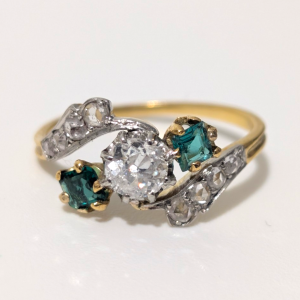
A slightly imperfect old European cut inside an Edwardian platinum ring often has considerably more character than replacing it with a technically “better” modern stone.
Its unevenness is part of the story.
The cutter who shaped that diamond could not see a computer-generated light performance map. He worked the rough stone individually, making decisions by eye and experience.
More than a century later, those decisions remain visible every time the diamond catches the light.
And that is precisely why old cut diamonds continue to be sought after.
Quick Comparison: Old Cut vs Modern Brilliant
| Characteristic | Old Cut Diamond | Modern Brilliant Diamond |
|---|---|---|
| Facets | Broad and chunky | Precise and numerous |
| Table | Usually smaller | Usually larger |
| Crown | Often high | More standardised |
| Culet | Frequently visible/open | Usually pointed or tiny |
| Symmetry | Often irregular | Highly symmetrical |
| Sparkle | Broad, slower flashes | Rapid, intense scintillation |
| Shape | Can be irregular | Precisely shaped |
| Character | Individual | Consistent |
| Common jewellery periods | Georgian, Victorian, Edwardian, early 20th century | Primarily modern jewellery |
Frequently Asked Questions
Are old cut diamonds real diamonds?
Yes. “Old cut” describes the way a diamond has been fashioned, not a different material. An old mine cut or old European cut can be a completely natural diamond just like a modern round brilliant.
Why does my old cut diamond have a hole in the middle?
What appears to be a small hole is often the open culet at the bottom of the diamond. Antique cutters commonly polished this area into a small facet rather than bringing the pavilion to a sharp point.
Are old mine cut diamonds rare?
Genuine antique examples are inherently limited because they come from historic production. Attractive larger old mine cuts have consequently become increasingly desirable among collectors and antique jewellery buyers.
Is an old European cut the same as an old mine cut?
No. They are related antique brilliant-style cuts, but old mine cuts are typically cushion-shaped while old European cuts are generally round and represent a later stage in diamond cutting development.
Do old cut diamonds sparkle less?
They usually sparkle differently rather than simply less. Modern brilliant diamonds are designed for highly efficient light return and rapid scintillation. Old cuts tend to produce fewer but broader flashes of light.
Can a jeweller tell whether a diamond is antique?
An experienced jeweller or gemmologist can often identify historical cutting characteristics, although assigning a precise age purely from the diamond is difficult. The setting, construction and provenance should also be examined.
Are old cut diamonds good for engagement rings?
Absolutely. Old mine and old European cut diamonds are increasingly sought after for engagement rings because each stone tends to have an individual appearance. Original antique rings and newly made rings containing antique diamonds are both popular choices.
Create Any Custom Diamond Piece You Want
We can source any diamond – old or modern cut and any other gemstone you may want for your piece. Any type of jewellery and any style is possible with our custom jewellery service, click the banner below to learn more and get started.